
Scaling out of a trade
Closing a position in pieces locks in some profit and leaves the rest running, but it also makes the final result harder to work out by hand. This calculator adds up each exit, the fees on it and the result relative to your original risk.
Formulas
Leg gross P&L = (Exit − Entry) × Qty for longs; (Entry − Exit) × Qty for shortsLeg fee = Fee% × (Entry × Qty + Exit × Qty)Net P&L = Σ gross − Σ feesR multiple = Net P&L ÷ (|Entry − Stop| × Position size)Worked example
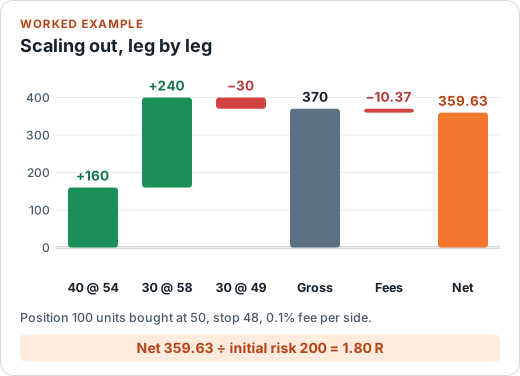
You buy 100 units at 50 with a stop at 48, and pay 0.1% per side. You sell 40 at 54, 30 at 58, and the last 30 at 49 when price returns.
- Leg 1: (54 − 50) × 40 = +160; leg 2: (58 − 50) × 30 = +240; leg 3: (49 − 50) × 30 = −30
- Gross = +370.00; fees = 4.16 + 3.24 + 2.97 = 10.37
- Net = 359.63; initial risk = 2 × 100 = 200; R multiple = 359.63 ÷ 200 = 1.80 R
Selling the final 30 units at a small loss still left the whole trade at +1.8 R because the two earlier exits had banked profit.
How to use it
- Choose long or short and enter your entry price and position size.
- Optionally add your original stop to see the result in R, and an estimated fee percentage.
- List each exit price with the quantity closed at that price. The total cannot exceed the position size.
Assumptions and limitations
- Fees are a flat percentage of traded value on both sides. Fixed commissions are not modelled.
- No swaps, funding, taxes or currency conversion. For leveraged futures costs use the Futures P&L Calculator.
- Moving your stop after entry changes your real risk. The R multiple here uses only the initial stop you enter.
Common mistakes
- Measuring R from the new, tighter stop instead of the original one.
- Forgetting fees on the partial exits.
- Counting profit on units that are still open.
FAQ
How are fees calculated?
Each exit leg is charged the fee percentage on the entry value and on the exit value of the quantity closed in that leg. Fees are therefore proportional to the part of the position you close.
What does the R multiple show?
It divides your net profit by your initial risk (distance from entry to stop, times the full position size). A result of 1.8 R means you made 1.8 times what you originally risked.
What if I haven't closed the whole position?
The calculator reports profit on the closed quantity only and tells you how much remains open. The open part is not valued.
Can I use it for shorts?
Yes. Choose Short; profit then comes from exits below your entry price, and the stop must be above entry.