
What this calculates
Leverage changes how much margin you post, not how much each price tick is worth. Profit and loss still come from the price move times your position size. What leverage does change is the return on margin, which is why a small move can be a large percentage gain or loss on the money you posted. This tool also takes off trading fees and funding so you see a net figure.
Formulas
Gross P&L = (Exit − Entry) × Quantity × Multiplier (short: (Entry − Exit) × …)Entry value = Entry × Quantity × MultiplierFees = Entry value × Entry fee% + Exit value × Exit fee%Funding = Entry value × Funding rate × Intervals × (+1 long, −1 short)Net P&L = Gross − Fees − FundingMargin = Entry value ÷ LeverageReturn on margin = Net P&L ÷ MarginWorked example
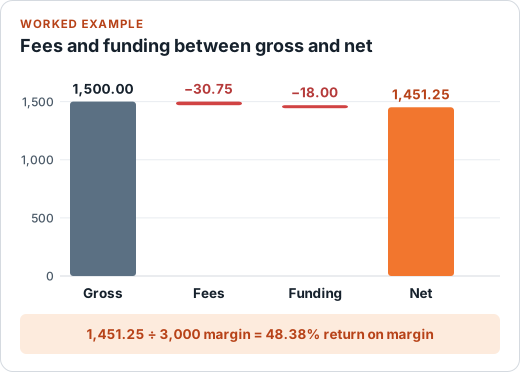
You go long 0.5 units at 60,000 and exit at 63,000, using 10× leverage, 0.05% fees each way, and hold through 6 funding intervals at +0.01%.
- Entry value = 30,000; margin = 30,000 ÷ 10 = 3,000.00
- Gross P&L = 3,000 × 0.5 = 1,500.00
- Fees = 30,000 × 0.0005 + 31,500 × 0.0005 = 15.00 + 15.75 = 30.75
- Funding paid = 30,000 × 0.0001 × 6 = 18.00
- Net P&L = 1,500 − 30.75 − 18 = 1,451.25, a return on margin of 48.38%
Flip the direction to Short with the same prices and gross P&L becomes −1,500.00, while the 18.00 funding becomes a receipt.
How to use it
- Choose the direction and enter entry, exit, quantity and leverage.
- Add your exchange's fee rates and the funding rate and number of intervals you expect to hold (use 0 if none).
- Read the net result and the return on margin. Compare it with the risk you planned using the Trade Planner.
Assumptions and limitations
- Linear contracts only. No inverse or quanto products.
- Fills at exactly the prices entered; no slippage, no partial fills.
- Funding is approximated on entry value. Real funding varies with mark price and the rate at each interval.
- Liquidation is not checked here. Use the Liquidation Price Estimator.
Common mistakes
- Thinking a higher leverage increases profit per price move. It only reduces the margin required.
- Leaving out funding on positions held for days.
- Entering a percent-style leverage such as 1000% instead of 10×.
FAQ
Does this work for inverse (coin-margined) contracts?
No. It models linear contracts, where profit is (exit − entry) × quantity in the settlement currency. Inverse contracts are settled in the coin and have a different, non-linear profit formula, so this tool would give wrong results for them.
Why is funding calculated on the entry value?
Real funding is charged at each funding time on the position value at that moment, using the exchange's mark price. This tool uses the entry value for every interval as a transparent approximation. If the price moved a lot, your real funding differs.
Who pays funding?
When the funding rate is positive, long positions pay and shorts receive. When it is negative the reverse applies. The tool follows that convention and shows funding as a cost (−) or a receipt (+).
What is the contract multiplier?
The number of underlying units one contract represents. Use 1 when you enter quantity directly in coins or units. Some products use other sizes; check the exchange's contract specification.