
How liquidation works, in principle
With isolated margin you post a slice of your balance as the initial margin, which is the position value divided by leverage. As price moves against you, that margin is eaten into. When what is left falls to the maintenance margin requirement, the exchange closes the position. The price where that happens is the liquidation price.
Formula used here
Initial margin rate = 1 ÷ LeverageLong: Liquidation ≈ Entry × (1 − Initial margin rate + Maintenance margin rate)Short: Liquidation ≈ Entry × (1 + Initial margin rate − Maintenance margin rate)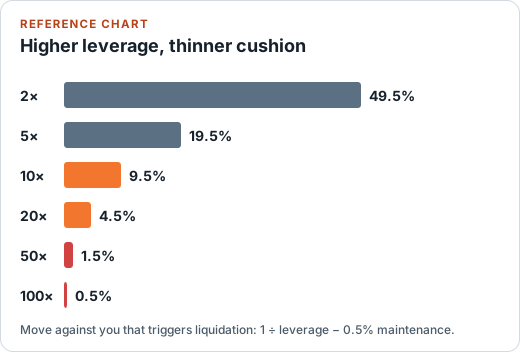
Worked example
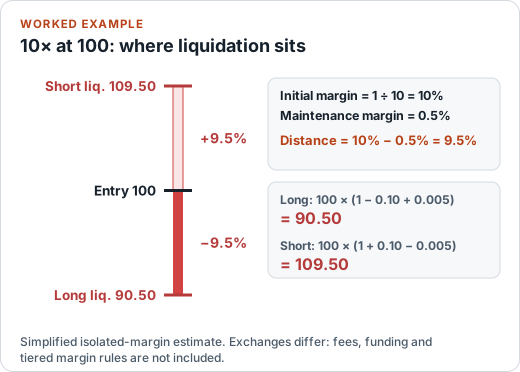
You open a 10× long at 100 with a maintenance margin rate of 0.5%.
- Initial margin rate = 1 ÷ 10 = 10%
- Liquidation ≈ 100 × (1 − 0.10 + 0.005) = 90.50
- Distance from entry = 9.50%
At 10× a move of roughly 9.5% against you ends the position, which is why a stop-loss placed before that level matters. A short at the same settings gives 109.50.
How to use it
- Choose long or short and enter your entry price and leverage.
- Enter the maintenance margin rate your exchange shows for your position size.
- Place your stop-loss comfortably inside the estimated liquidation price, not beyond it.
Assumptions and limitations
- Isolated margin and linear contracts only.
- Ignores trading fees, funding payments, any liquidation fee, and tiered maintenance margin (which can change with position size).
- Exchanges liquidate on mark price, which can differ from the last traded price you see on a chart.
- Real liquidation can be triggered earlier than this estimate. Do not rely on it for risk limits.
Common mistakes
- Setting a stop-loss beyond the liquidation price, so it can never act.
- Using the same maintenance rate for very different position sizes.
- Assuming cross-margin liquidation behaves like isolated margin.
FAQ
Is this the price my exchange will liquidate me at?
No. It is a simplified estimate. Exchanges liquidate against a mark price, apply tiered maintenance margin rates, may include fees in the calculation and use their own formulas. Always check your exchange's own liquidation price and treat this figure as an approximation only.
What maintenance margin rate should I use?
Use the rate your exchange lists for your position size and instrument. Small positions often have a low rate (a fraction of a percent), and the rate usually rises for larger positions. If you don't know it, check the exchange's risk limit table.
What about cross margin?
This estimate assumes isolated margin, where only the margin assigned to the position is at risk. With cross margin the rest of your account balance supports the position, so the real liquidation price is further away, but you can lose more than the single position's margin.
Why does it refuse some leverage values?
If the maintenance margin rate is as large as the initial margin (1 ÷ leverage), the position would start at the liquidation threshold. The tool reports that instead of a meaningless price.