
What a pip is worth
A pip is a standard unit of price movement. Its cash value depends on three things: the size of the pip for that instrument, how many units you hold, and the currency your account is denominated in. A pip on one lot of EUR/USD is not worth the same as a pip on one lot of USD/JPY, and neither is worth the same to a GBP account as to a USD account.
Formula
Pip value in quote currency = Pip size × Units per lot × LotsPip value in account currency = Pip value in quote currency × (account currency per 1 quote currency)Worked example
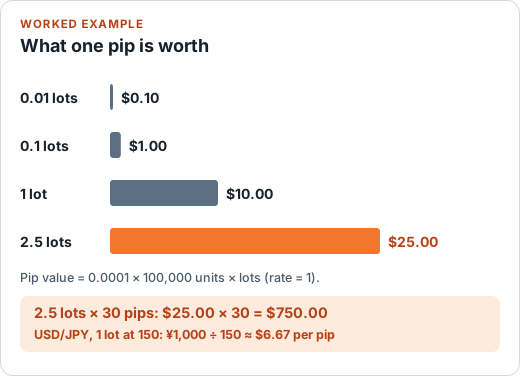
You hold 2.5 lots of EUR/USD in a USD account. One lot is 100,000 units and the pip size is 0.0001. Because the quote currency (USD) is your account currency, the rate is 1.
- 1 pip on 1 lot = 0.0001 × 100,000 = 10.00
- 1 pip on 2.5 lots = 10.00 × 2.5 = 25.00
- A 30-pip move = 25.00 × 30 = 750.00
For USD/JPY with a USD account, one lot has a pip value of 0.01 × 100,000 = 1,000 yen. If USD/JPY trades at 150, one yen is worth 1 ÷ 150 of a dollar, so enter a rate of 0.006667 and one lot is worth about 6.67 per pip.
How to use it
- Enter the pip size and lot size from your broker's contract specification.
- Enter your position in lots.
- Enter the exchange rate that converts the pair's quote currency into your account currency (use 1 if they are the same).
- Optionally enter a pip distance, for example the distance to your stop-loss, to see its cash value.
Using the result
Pip value is the bridge between a stop-loss distance in pips and an amount of money at risk. If you risk 100 and your stop is 25 pips away, the pip value you can afford is 4.00, which on EUR/USD is 0.4 lots. The Position Size Calculator performs this sizing directly when you work in price units.
Assumptions and limitations
- The exchange rate is whatever you type. A stale rate produces a stale pip value.
- Contract size, pip size and rounding vary between brokers and instruments. Verify them on your platform.
- Spread, commission, swap and slippage are not included.
Common mistakes
- Entering the base currency's conversion rate instead of the quote currency's.
- Using forex lot sizes for metals, indices or crypto CFDs.
- Forgetting that yen pairs use a 0.01 pip.
FAQ
How do I find the pip size for a pair?
For most forex pairs a pip is 0.0001 (the fourth decimal place). For pairs quoted in Japanese yen, such as USD/JPY, a pip is usually 0.01. Some brokers also quote fractional pips (pipettes). Check the contract specification your broker publishes for the exact instrument.
Which exchange rate do I enter?
Enter how much one unit of the pair's quote currency (the second currency) is worth in your account currency. If your account is in USD and you trade EUR/USD, the quote currency is USD, so the rate is 1. If you trade USD/JPY with a USD account, the quote currency is JPY, so enter 1 ÷ the current USD/JPY price. SOFTYTOOLS does not fetch live rates, so you stay in control of the figure.
Does this work for gold, indices and crypto CFDs?
Only if you enter that instrument's own pip (or point) size and contract size. Those values differ by broker. For example, a lot of one metal or index CFD is not 100,000 units. Use your broker's specification table instead of assuming forex defaults.
Why is my broker's pip value slightly different?
Brokers round pip values, use their own live conversion rate, or define a lot differently. Treat the result here as a planning figure and confirm it against your platform before sizing a real trade.